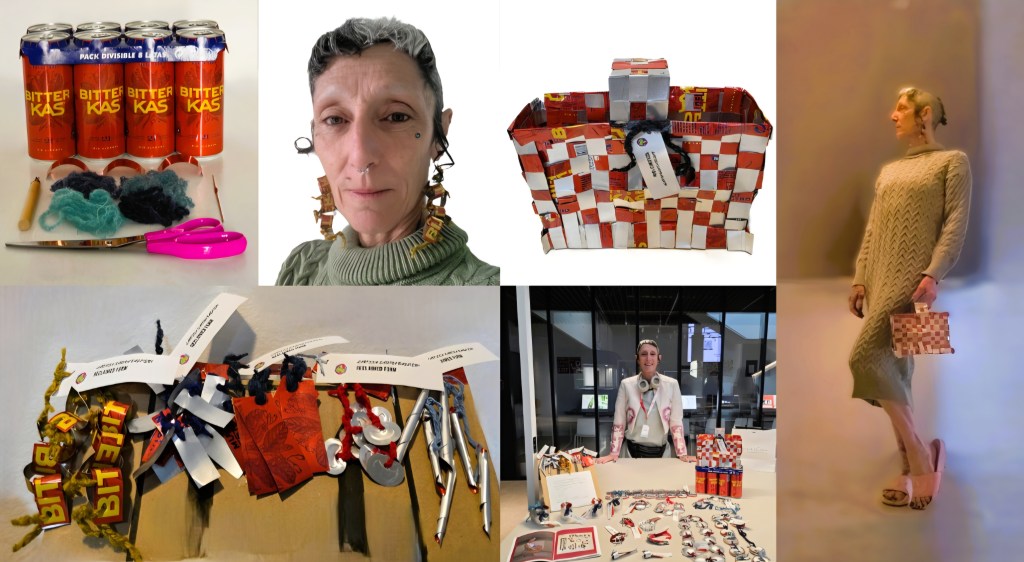
From consumption to creation – this collection transforms discarded aluminium cans into wearable forms. Through repetition, each piece reimagines waste as structure, ornament, & narrative. Image source: Larissa Baglieri
There’s something quietly radical about refusing to buy new materials.
For my Textile Products & Sustainability project at LCI Barcelona, we were given a deceptively simple brief – choose one object & create a minimum of ten accessories through repetition. The constraint? Maintain the integrity of the original object’s form while increasing complexity across outcomes.
I chose the aluminium can – specifically, the Bitter KAS cans that had become part of my daily rhythm. It felt honest. Immediate. Already embedded in my life. Instead of sourcing materials, I turned to what I was already consuming, shifting the can from waste into resource.
This decision anchored the entire project in sustainability – not as an aesthetic, but as a practice.
Material as System, Not Surface
Working with aluminium forced me into a different relationship with material. Every part of the can became an opportunity.
The ring pulls became structural connectors & focal points. The punched mouth opening transformed into small sculptural elements. The printed text introduced colour, typography, & identity. The top & base offered rigid forms for more complex constructions. Nothing was discarded. Every cut was considered.
To bind the pieces, I used salvaged thread, crocheting connections between fragments. This added a softness against the industrial sharpness of the aluminium – an unexpected dialogue between craft & waste.
From Simple to Complex
The progression of the project followed a clear trajectory – begin with simplicity, then push into complexity.
I started with rings, earrings, & bracelets, isolating single repeated shapes to understand their potential. These early pieces were about restraint – learning how far one cut form could go.
From there, I moved into layered bracelets, necklaces, & belts, incorporating larger sections of the can & experimenting with structure & movement. The designs became more tactile, more expressive.
One of the most exciting discoveries was the star/sun motif formed from the base of the can. It carried a kind of symbolic energy – something radiant emerging from waste.
Then came the challenge piece – the handbag.
Weaving Waste into Form
The handbag marked a turning point.
I cut the aluminium into rectangular segments & wove them into panels, creating a flexible yet structured surface. These panels were then joined – through the weave itself – to construct the sides, base, & handle.
It was a slow, deliberate process. Slightly unforgiving (aluminium doesn’t exactly ‘forgive’ mistakes), but deeply satisfying.
What emerged was not just an accessory, but a prototype – something with real potential for further development. It holds the memory of its origin while functioning as a contemporary object.
That tension is where the work becomes interesting.
Sustainability as Practice, Not Trend
This project reinforced something I keep coming back to – sustainability isn’t just about materials. It’s about mindset.
It’s about seeing value where others see waste, working within constraints rather than around them, & designing with awareness of lifecycle, not just aesthetics.
By using a single, discarded object & pushing it across multiple forms, I was able to explore not only design variation, but also material responsibility.
Community, Exchange, & Response
The project culminated in a pop-up exhibition at LCI Barcelona, where students, mentors, & visitors engaged with the work. Seeing the pieces outside of my own hands, being discussed & handled, shifted the work into a new space.
A few pairs of earrings have already found new homes, which feels like a full-circle moment – from consumption, to creation, back into circulation.
What Comes Next
The handbag, in particular, is something I want to develop further. There’s potential to refine the construction, explore scale, & push the modularity even more.
But for now, I’m stepping away.
I’m heading into Easter break, spending time in Ireland & the UK – resetting, refilling the creative well, & letting ideas settle. There’s something important about that pause. Not everything needs to be solved immediately.
Sometimes the best next move is to step back… & come back sharper.
This project has reminded me that innovation doesn’t always come from adding more.
Sometimes, it comes from choosing one thing – & seeing just how far it can go.
 Larissa Sarina BAGLIERI