
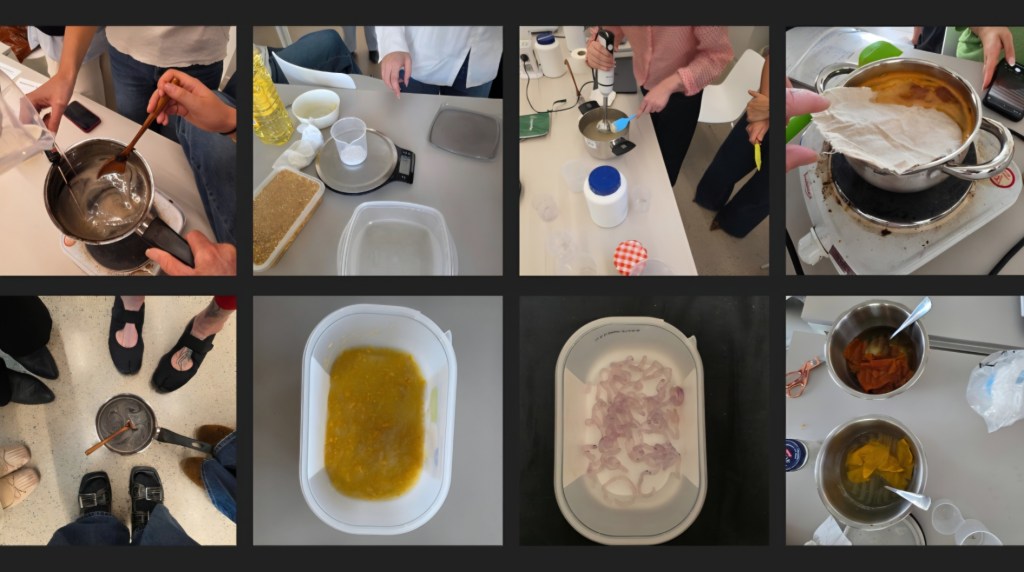
Moments from recent biodegradable material workshops – experimenting with coffee composites, orange peel bioplastics, alginate bio yarn, & natural dyes. A process of observation, unpredictability, & learning to work with materials rather than controlling them.
Over the past few weeks, I’ve been immersed in a series of biodegradable material workshops, experimenting with organic matter, natural binders, & traditional dye processes. This collection of images captures moments from that process – the in-between stages of mixing, heating, pouring, waiting, & observing as materials slowly transformed.
What stood out most was the shift in control. These materials don’t behave like conventional textiles. They respond to time, temperature, movement, & environment in ways that are often unpredictable. A surface that appears stable can continue to change, soften, or even break down. In some cases, outcomes that might initially be seen as failures, uneven textures, inconsistencies, or even mould, revealed something more honest about the nature of the material itself.
Each experiment offered a different material language. A dense coffee-based composite formed something closer to a structural surface. An orange peel mixture created a soft, unstable membrane that continued to evolve over time. An alginate-based bio-yarn produced gestural, filament-like forms shaped directly by movement. Natural dye processes using turmeric demonstrated a more controlled transformation, where mordants shifted colour from vibrant yellow to deeper, earthier tones.
Together, these explorations highlighted both the potential & the limitations of biodegradable materials. While they offer rich sensory qualities & strong connections to sustainability, they also raise important questions around durability, storage, & transport – particularly when considering global contexts where strict regulations around organic materials exist.
This is not new territory for me. I’ve previously worked with natural dyes, kombucha SCOBY, & waste wool, & these workshops have reinforced my interest in continuing to explore these processes further. What feels most relevant moving forward is not the idea of replacing conventional materials entirely, but integrating biomaterials into fashion in a more considered way – as hybrid elements, surface applications, or components that are designed to change over time.
Rather than striving for perfection, these materials invite a different approach – one that embraces imperfection, transformation, & the passage of time as part of the design process.
This is just the beginning.

