Biomaterials | Identity, Migration & Transformation
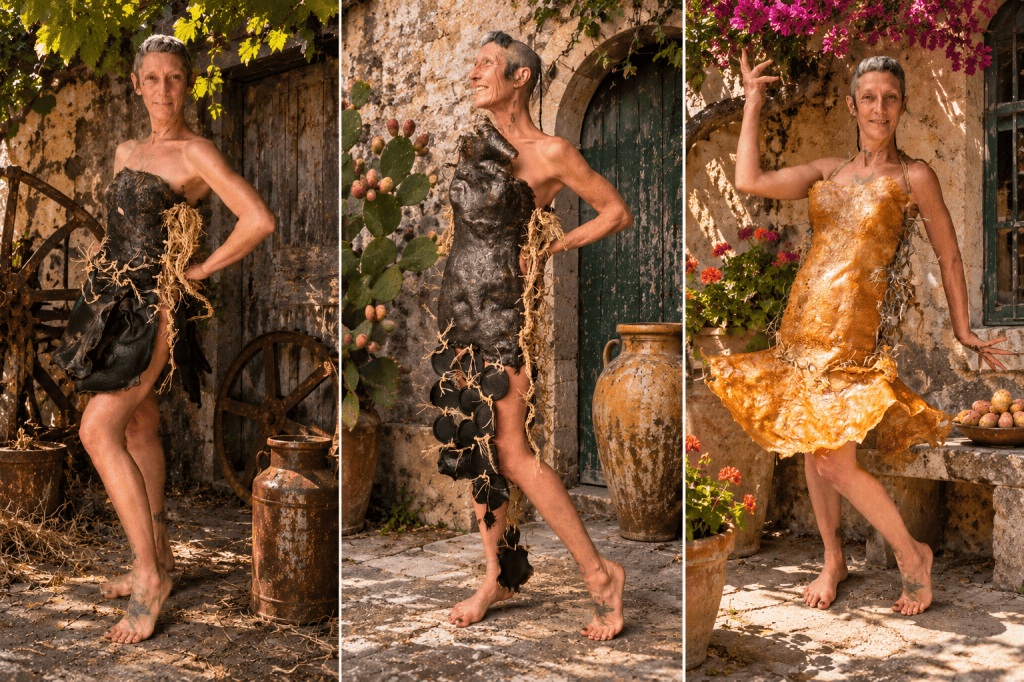
AI-assisted editorial imagery developed from photographs of my original wearable artworks.
Biomaterials, Ancestral Knowledge & The Creative Process Of Becoming
My creative practice has always been driven by curiosity, experimentation & a desire to explore possibilities beyond the conventional. I am interested not only in what materials can become, but in the histories they carry, the assumptions we make about their value & the ways in which transformation can challenge our perceptions.
For many years, I have wanted to immerse myself more deeply in the exploration of biomaterials. My initial investigations included kombucha, natural dyes, wool & other organic materials, alongside a growing curiosity about the potential of cactus, cane & alternative plant-based resources. Yet, despite my fascination, there never seemed to be enough time to fully explore the possibilities.
That changed during my studies at LCI Barcelona.
My exposure to new approaches to textile experimentation, sustainability & material innovation encouraged me to reconsider how I could incorporate these investigations into my own practice. Rather than continuing to treat biomaterials as something I would explore when time permitted, I made a conscious decision to prioritise them within my graduate collection.
What began as an interest in alternative materials has evolved into a much deeper investigation of identity, migration, transformation & the relationship between human consumption & the natural world.
Three Bodies, One Collection
My graduate collection explores three interconnected themes: Identity, Migration & Transformation.
These concepts are expressed through three distinct bodies of work:
Salvaged Materials – Reconstructing discarded industrial & domestic materials into sculptural, architectural forms that challenge conventional expectations of fashion.
Biomaterials – Exploring organic materials, natural processes, decomposition, regeneration & the possibilities of creating wearable forms from resources commonly considered waste.
Repurposed Garments – Deconstructing & reconstructing existing clothing, including martial arts uniforms & emergency services garments, to investigate identity, restriction, protection, movement & transformation.
Although each body of work has its own material language, they are connected by a shared philosophy: challenging what we perceive as valuable, useful, beautiful or disposable.
My interest lies in what already exists, what has been overlooked & what might emerge when we question an object’s original purpose.
Migration: Materials, Memory & Ancestry
Migration is central to my collection, extending beyond the physical movement of people across geographical boundaries. It is also the migration of materials, ideas, traditions, knowledge & identity.
My paternal Sicilian ancestry has influenced the way I understand resourcefulness, making & the relationship between necessity & creativity. Growing up, I learnt the importance of making do with what was available. Repairing, reusing, adapting & finding alternative solutions were not necessarily described as sustainable practices. They were simply part of everyday life. These experiences established a relationship with materials that continues to influence my artistic practice.
I am interested in how knowledge travels between generations, how cultural identities evolve through migration & how the things we carry, both physically & psychologically, become part of who we are. There is a parallel between the migration of people & the transformation of materials.
Both are shaped by their environments. Both carry traces of their origins. Both undergo processes of adaptation, sometimes through necessity, sometimes through opportunity. Neither remains entirely unchanged.
The Dystopian Landscape
Dystopia is another influence within my collection. I am fascinated by the contradictions of contemporary society, particularly the extraordinary capacity for innovation alongside our willingness to consume, discard & destroy resources.
The fashion industry generates enormous quantities of textile waste, while the food industry discards organic materials that still contain possibilities for alternative uses. These systems are often considered separately, yet both are connected through patterns of production, consumption & disposal. My biomaterial investigations bring these two industries into conversation.
What happens when food waste becomes a textile? What happens when something intended to be consumed becomes something worn? Can an organic material challenge our expectations of fashion, permanence & value?
I am not suggesting that biomaterials alone provide a solution to the environmental consequences of industrial production. They present their own challenges concerning durability, resources, preservation & practical application. However, they create opportunities to question existing systems & investigate alternatives.
The dystopian influence is not simply about imagining a damaged future. It is about recognising the contradictions already present in our world & exploring how creativity might contribute to different possibilities.
Growing, Casting & Constructing
My recent experiments have focused on developing biomaterials using coffee, citrus, beetroot & black cherry working with ingredients including gelatine, glycerine & vinegar. These investigations involve a process of mixing, heating, casting, drying, observing & responding to the material as it changes.
Unlike conventional textiles, biomaterials cannot always be expected to behave predictably. They shrink, curl, crack, stretch, distort & respond to environmental conditions. Initially, these behaviours might be interpreted as failures. However, I have become increasingly interested in allowing the materials to reveal their own characteristics rather than attempting to impose complete control.
A split surface can become a design feature. Uneven thickness can produce unexpected texture. Shrinkage can create sculptural movement. The resulting garments are not intended to imitate conventional fabric. Their irregularities, translucency, fragility & organic surfaces are fundamental to their identity. I have incorporated raffia, including naturally dyed elements, to bind & connect sections, allowing the construction process to remain visible.
These connections are significant to me. They reference the act of joining, repairing & reconstructing, while also suggesting the relationships between fragments of identity, memory & experience.
The materials are not simply assembled into garments. They become part of an ongoing conversation between my intentions & their own physical behaviour.
Transformation Beyond The Material
Transformation has always been central to my artistic practice, but it extends far beyond the physical alteration of an object. For me, creativity is a way of learning, growing & reconstructing my own perceptions. I have an almost constant stream of thoughts, questions & possibilities moving through my mind. Curiosity drives me to investigate, experiment & challenge what I think I understand.
Sometimes this manifests as overthinking. Sometimes it leads me down unexpected paths that seem to have little connection to my original intention. Yet these processes are often where the most interesting discoveries emerge.
I question why something is done in a particular way, whether another approach is possible & what might happen if I deliberately challenge an established assumption. The process of making allows me to explore these questions physically.
Rather than simply thinking about possibilities, I can test them, experience their limitations & respond to the outcomes. This is also how I continue to challenge my own perceptions.
An unsuccessful experiment may reveal an unexpected direction. A material that refuses to behave as anticipated may demand a different solution. An idea that initially appears impractical may lead to an entirely new understanding.
I am not interested in eliminating uncertainty from my practice. I am interested in what uncertainty can teach me.
Sustainability As A Way Of Thinking
Sustainability, for me, is not simply about selecting an environmentally preferable material. It is about questioning the systems of value that determine what we keep, what we discard & what we consider worth transforming.
My use of salvaged materials, repurposed garments & experimental biomaterials reflects an approach to making that has developed throughout my life. It is grounded in resourcefulness, curiosity & the belief that limitations can become opportunities for innovation.
I am interested in the creative potential of what already exists, rather than automatically seeking something new. This does not mean that every experiment will produce a practical or environmentally sustainable outcome. Some materials will fail. Others may have limited lifespans. Certain processes may require further investigation before their environmental benefits can be properly understood. These questions are part of the work.
I believe that meaningful exploration requires acknowledging contradictions rather than presenting sustainability as a simple or complete solution.
Wearing The Experiment
Seeing these biomaterial garments on my own body has been an important part of the process. Until this point, much of my experimentation involved observing materials as individual sheets, surfaces & sculptural forms. Wearing them introduces another dimension.
The body changes how the materials are perceived. Movement reveals qualities that are not necessarily apparent when the garments are stationary. Light interacts with their surfaces, exposing variations in thickness, texture & translucency.
The coffee biomaterial presents a dark, textured surface with an almost weathered quality, while the golden tones of the citrus-based material suggest something more luminous & fluid. Both retain visible evidence of their making. Their irregularities are not concealed. They are celebrated as part of their individual character.
These garments also challenge the distinction between sculpture, fashion & performance. They are wearable, but they are not intended to function as conventional everyday clothing. They are experimental forms that explore the relationship between material, body, movement & meaning.
The Process Of Becoming
Perhaps the most significant aspect of this work is that it remains an ongoing investigation. Although the garments are now constructed, there are still accessories to complete & further possibilities to explore.
I am particularly interested in extending the biomaterial investigations into footwear, using wooden soles & raffia to create connections between the different elements. There are also other materials I want to investigate, including cactus & cane, alongside further experimentation with natural dyes & alternative organic resources.
I do not see the completion of these garments as the conclusion of my exploration. Instead, they represent another stage in a much longer process of learning.
My practice is not driven by the need to arrive at a predetermined outcome. It is driven by the desire to discover what might become possible through experimentation, questioning & transformation. The three bodies of my collection may appear materially different, yet they share the same underlying intention. To reconsider what already exists. To recognise the potential within what has been discarded. To acknowledge the histories carried by people, objects & materials. To explore how identity, like matter itself, is continually reconstructed through experience.
For me, transformation is not simply the act of turning one thing into another. It is the willingness to question what something is, what it has been & what it might still become.

