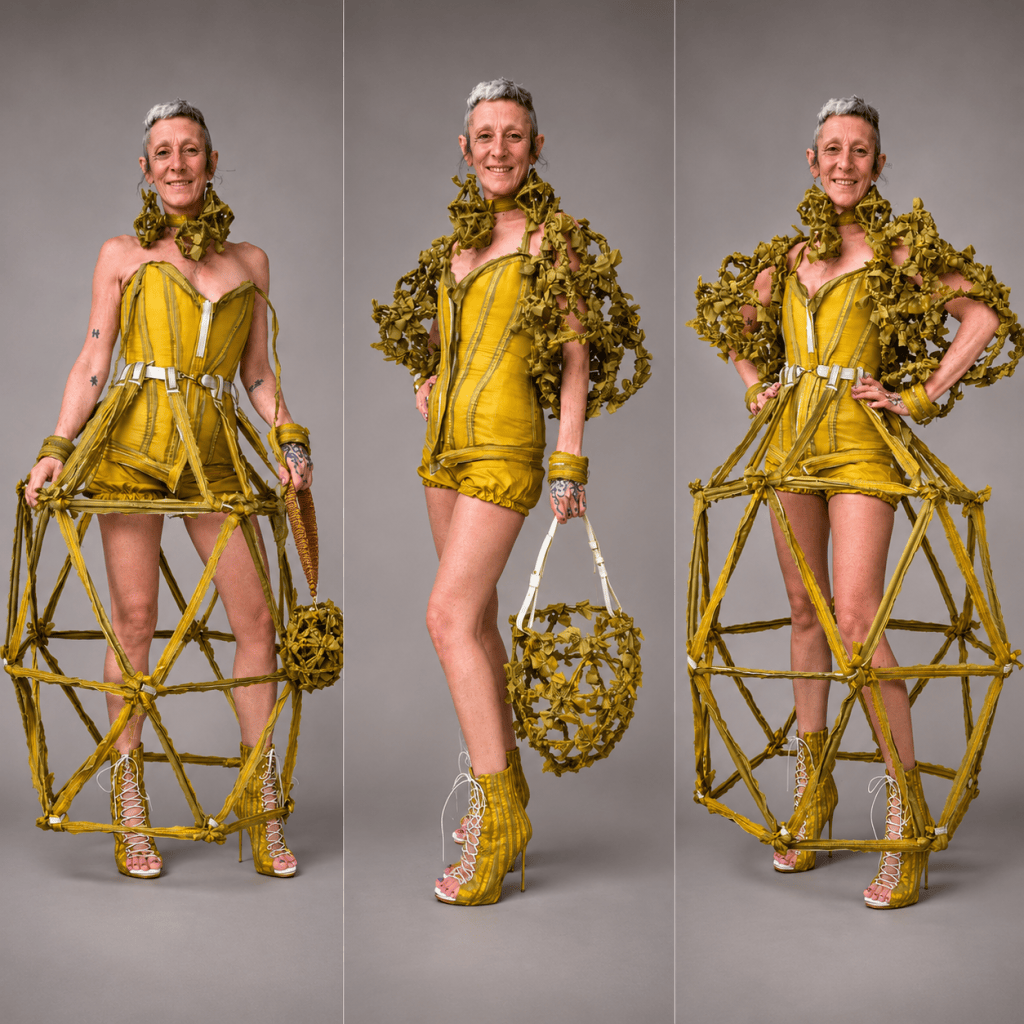
Hexagon – Wearable art created from salvaged hot-air balloon materials, exploring the relationship between consumption, environmental responsibility & transformation. The editorial image incorporates AI-generated elements, prompting further reflection on the environmental costs of digital creation.
The Hidden Cost Of What We Wear
Fashion is an extraordinary form of expression. It communicates identity, culture, belonging, rebellion & transformation. Yet behind the beauty, creativity & individuality of what we wear lies an industry responsible for significant environmental & social harm.
Fast fashion has normalised the continual production, consumption & disposal of clothing. Garments are manufactured cheaply, transported across the world, worn briefly & frequently discarded. Mountains of textile waste are a visible consequence, but what concerns me equally is the environmental damage occurring long before garments reach landfill, & long after we purchase them. The production of textiles consumes water, energy, chemicals & natural resources. Synthetic fibres, many derived from fossil fuels, introduce another persistent problem: microplastics.
Everyday activities, particularly laundering synthetic clothing, release microscopic fibres into wastewater. Some are captured during treatment, while others enter waterways or accumulate in sewage sludge, which may subsequently be applied to land. These particles can move through ecosystems, affecting environments far removed from where the garments were originally manufactured or worn.
What makes this particularly confronting is that environmental harm is not confined to irresponsible disposal. It is also embedded in ordinary routines, including washing the clothes we already own.
The consequences of fashion extend throughout the garment’s life cycle, from fibre production, dyeing & manufacturing to transportation, laundering & disposal. There is no single stage responsible for every form of damage. This challenges the idea that donating unwanted clothing or purchasing something labelled sustainable is enough to address the problem.
Hexagon: Making The Invisible Visible
Hexagon was created using salvaged hot-air balloon materials from Global Ballooning, transforming textiles originally designed for flight into a sculptural form worn around the human body.
The construction draws inspiration from a geometric light fitting, reimagined as a three-dimensional wearable structure. Bamboo, repurposed balloon fabric, ropes & other components form an architectural framework that explores the relationship between the body, material, space & movement. The corset, shorts, sculptural sleeves, accessories & footwear extend this process of transformation, creating a relationship between the individual elements of the ensemble.
One of my deliberate construction choices was to leave threads exposed rather than conceal them within perfectly finished surfaces. These visible threads are not simply an aesthetic decision. They draw attention to something we rarely consider: the fibres continually being released from the textiles surrounding us.
Synthetic clothing can shed microscopic fibres through everyday wear, friction & laundering. Many of these particles are invisible to the naked eye, yet their release contributes to a much larger environmental problem.
The exposed threads of Hexagon do not represent microplastics themselves. Rather, they become a visual reminder of what we cannot ordinarily see. By exposing the threads, I am asking the viewer to consider the invisible consequences of our everyday choices. What happens to the fibres released when we wash our clothing? Where do they travel? What happens when they enter our waterways, soil & ecosystems? The artwork makes visible a process that is usually hidden from our awareness.
Geometry, Crystals & The Transformation Of Identity
The geometric construction of Hexagon carries meanings extending far beyond its physical form. Triangles, diamonds & pyramidal structures have particular significance to me through my involvement with Alcoholics Anonymous (AA) & Narcotics Anonymous (NA), where geometric symbolism has influenced my understanding of recovery, connection, balance & personal transformation. These shapes have become part of my visual language, representing the ongoing process of rebuilding identity, questioning established beliefs & discovering new ways of living.
The hexagonal structure also reminds me of a crystal. My fascination with crystals extends beyond their visual beauty. Through listening to scientific podcasts exploring quantum physics, matter, energy & the natural world, I have become increasingly interested in the structures & processes that underpin our physical existence.
Crystals are particularly fascinating because their ordered atomic arrangements can produce extraordinary geometric forms. Their relationship with light, reflection & refraction offers possibilities for exploring what is visible, what remains hidden & how our perceptions change. I interpret these scientific ideas symbolically within my artistic practice, rather than as evidence of supernatural properties.
Another important influence comes from my childhood. I remember watching Jim Henson’s The Dark Crystal, a film whose extraordinary creatures, costumes, environments & storytelling have remained with me. Its dystopian world explores division, displacement, exploitation, the destruction of natural balance & the struggle to restore life & connection.
The crystal itself becomes a powerful symbol of a fractured world, while the film’s treatment of life force raises questions about what happens when power is maintained through the exploitation of others. These ideas resonate with my concerns about environmental destruction, resource consumption & the unequal consequences experienced by communities across the world.
The film’s costumes also demonstrate how clothing can communicate identity, culture, hierarchy & belonging without relying on conventional fashion. This has particular relevance to my own wearable art practice, where garments become sculptural extensions of the body, carrying stories beyond their practical function.
Migration is central to these connections. Whether through the displacement of communities, the movement of people seeking safety, or the transformation of materials from one purpose to another, migration involves both loss & possibility.
The dystopian landscapes that inspire my editorial imagery are therefore not simply aesthetic choices. They reflect questions about environmental degradation, displacement, survival & the possibility of regeneration.
Within Hexagon, the combination of triangular forms creates a larger structure that surrounds the body while remaining open to the environment. I see this as a reflection of my own experience: the structures that have shaped my identity, the challenges of moving through them & the continuing possibility of transformation.
The original inspiration of a light fitting introduces another symbolic connection. Light reveals what darkness conceals. It can expose uncomfortable realities, but it can also represent understanding, connection & hope. This is particularly meaningful in relation to my peer support work & the possibility of developing Hexagon into a future artwork titled Shining a Light.
For me, the relationship between geometry, crystals, light & transformation is not about achieving perfection or discovering a single universal truth. It is about recognising the extraordinary complexity of existence, remaining curious about what I do not understand & finding ways to communicate those questions through art.
Just as a crystal’s structure can interact with light to reveal different facets, our understanding of ourselves & the world changes as we encounter new experiences, knowledge & perspectives.
This is where my concept of Ordered Kaos becomes particularly meaningful. Structure & disorder are not necessarily opposites. They coexist within nature, within societies & within ourselves. My artwork emerges from that relationship, transforming salvaged materials, personal experiences, scientific curiosity & childhood memories into something that continues to evolve.
The Contradiction Of Digital Creation
While documenting Hexagon, I encountered another contradiction within my creative practice. I wanted to use artificial intelligence to replace the backgrounds of photographs showing my completed artwork. My intention was straightforward: preserve my actual appearance, the garment & its construction while exploring alternative editorial environments.
Instead, the generated images repeatedly altered my face, hair, body & the details of the artwork itself. I continued trying to achieve an accurate result, becoming increasingly frustrated by the unnecessary alterations. Eventually, I stopped. Not simply because the images were unusable, but because I began questioning the environmental cost of continuing.
Artificial intelligence is often presented as something intangible, existing somewhere in an invisible digital world. Yet the infrastructure supporting it is profoundly physical. Data centres require electricity, cooling systems, water & substantial infrastructure. Depending on their location, energy sources & cooling technologies, they can contribute to greenhouse gas emissions, water consumption & additional pressure on surrounding communities.
The consequences of technological development are not distributed equally. Communities living near infrastructure, or affected by the extraction of materials required to build it, may experience costs that are largely invisible to the people using these technologies.
I could not calculate the precise environmental footprint of my unsuccessful image generations. However, I could recognise that continuing to request more images was consuming additional resources without producing something useful.
I had to ask myself a question. Was achieving the image I wanted more important than the environmental values I was trying to communicate through the artwork itself? The answer was no. I had to let it go. That moment became more meaningful than the image I had originally intended to create.
It reminded me that environmental responsibility is not simply about the materials we choose. It is also about recognising when to stop, questioning our expectations & accepting that not every desired outcome justifies the resources required to achieve it.
Identity, Migration & Transformation
The three concepts underpinning my graduate collection – Identity, Migration & Transformation – extend far beyond the garments themselves. Identity encompasses our personal histories, cultural connections, lived experiences & the values through which we understand ourselves & the world.
Migration is not always a voluntary journey towards opportunity. Across the world, people are displaced by conflict, persecution, poverty, environmental degradation & climate-related disasters. Drought, flooding, extreme weather, resource scarcity & the loss of livelihoods can force individuals, families & entire communities to leave places they call home.
The environmental consequences of overconsumption are not experienced equally. Those contributing least to global environmental damage can be among the most vulnerable to its consequences. This is one reason dystopian environments resonate with my artistic practice. They are not simply dramatic settings for fashion photography. They represent possible futures, but also realities already being experienced by people around the world.
Abandoned buildings, damaged landscapes & structures reclaimed by nature raise questions about what we leave behind, what survives & how life continues through disruption. Migration also exists within the materials I use. A discarded textile moves from one purpose to another. Its original identity is altered, yet traces of its history remain.
Transformation occurs through this process of reimagining, reconstructing & creating new meaning. In Hexagon, salvaged materials become a structure surrounding the body, occupying space while simultaneously revealing the person within it. For me, this relationship between the body, material & environment is inseparable from questions of identity, freedom, restriction & belonging.
Living With Ordered Kaos
I do not believe that living sustainably requires pretending to be perfect. I make choices that contradict my values. I use technology, consume electricity, purchase materials when necessary & participate in systems whose environmental consequences I cannot always avoid.
I also recognise that my knowledge is incomplete. What I believe today may change as I encounter new information, different perspectives & a deeper understanding of the consequences of my actions. That is not something I consider a failure. It is an essential part of learning.
I want to remain capable of questioning my own beliefs rather than defending them simply because they are familiar. I want to recognise when my actions conflict with my intentions, acknowledge those contradictions & make changes where I can.
Sometimes that means creating something from materials others have discarded. Sometimes it means repairing rather than replacing. Sometimes it means refusing to purchase something I do not need. Sometimes it means switching off a technology, accepting an imperfect outcome & recognising that continuing would serve little purpose beyond satisfying my own expectations.
My life, like my artistic practice, exists within what I call Ordered Kaos. It is a space where contradictions coexist, where structure emerges from disorder, where identity is continually questioned & where transformation is never entirely complete. I cannot control every consequence of the systems in which I live. I can, however, take responsibility for the choices available to me.
Shining A Light
The completion of Hexagon has also prompted me to consider how the artwork might evolve. I am particularly interested in exploring illumination within its geometric framework, creating a relationship between light, shadow, visibility & the human body.
The working title Shining A Light carries a personal connection to a peer support publication featuring lived experiences of veterans & serving personnel, which included one of my artworks during the Royal Commission into Defence & Veteran Suicide. Shining a Light: Stories of Trauma & Tragedy, Hope & Healing | Royal Commission into Defence and Veteran Suicide
This connection introduces another dimension to the work: the importance of making visible what is too often overlooked, unheard or hidden. Environmental destruction, displacement, human suffering & the consequences of consumption are interconnected through systems that can distance us from the people experiencing their effects.
Art provides an opportunity to challenge that distance. Not necessarily by providing answers, but by encouraging questions. Who benefits from the things we consume? Who bears the consequences? What are we willing to change? How do we find hope without denying the realities confronting us?
For me, hope is not the belief that everything will somehow resolve itself. Hope exists in our capacity to reflect, learn, connect & transform. I am not perfect. My artwork is not without environmental cost. My lifestyle is not entirely sustainable. But I am willing to question myself, acknowledge my limitations & continue making changes.
I am doing my best to live in a way that minimises the harm I contribute to the world, while accepting that I am human, that I will make mistakes & that I still have much to learn. That is what living with Ordered Kaos means. Not eliminating every contradiction, but learning to navigate them with awareness, compassion & responsibility. Being comfortable with who I am today, without becoming unwilling to change who I may be tomorrow.
Identity is not fixed. Migration is not always geographical. Transformation is not an endpoint. It is an ongoing process of becoming. Sometimes, the most meaningful transformation begins with knowing when to stop.

